Shadow
Your workday, remembered.
"I know I worked all day.
I just can't remember on what, for whom,
or whether any of it mattered."
Your workday, remembered.
"I know I worked all day.
I just can't remember on what, for whom,
or whether any of it mattered."
You opened tabs. You were in meetings. You wrote some code, or reviewed some, or maybe just talked about code. Someone asked you for something and you said yes. You're not sure you wrote it down.
By Friday you can reconstruct maybe 60% of your week. The rest is blur. This is not a productivity failure. It's a memory architecture problem. Your brain acts. Shadow records.
Calendar apps track meetings. Time trackers track apps. Coding tools track keystrokes. Note apps track what you write down. None of them talk to each other.
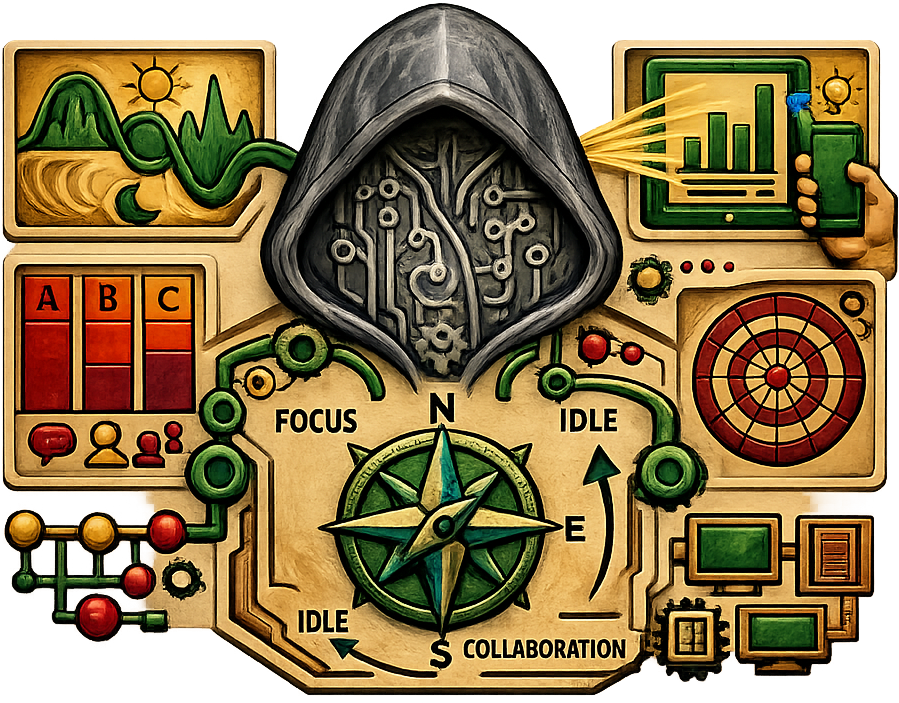
Shadow connects them. A branch switch in a million-file monorepo suppresses file noise automatically — then git confirms the tree is clean and the session resumes. A verbal commitment in a standup gets linked to the calendar event and tracked against what landed in the repo by the deadline. Your attention score is fused into every activity record so "worked all day" comes with "…and was actually present for 60% of it."
The Quantified Self movement coined a phrase: "self-knowledge through numbers." Practitioners track inputs — sleep, nutrition, environment. States — mood, energy, blood oxygen. Outputs — cognitive performance, creative throughput. Then they run structured experiments. Not population science. Not averages. Personal science, about one specific human: themselves.
Your professional life has never had the same rigour. You have opinions about when you're most productive. You don't have data. Shadow closes that gap. It instruments your workday the way a serious self-experimenter would: attention trajectories, context-switch cost measured in real minutes, deep-work density per project, verbal commitments tracked against what actually landed in the repo. You are the researcher. Your workday is the experiment. The lab never leaves your machine.
There's an old story about blind men and an elephant. One grabs the trunk and says "snake." One feels the leg — "tree." One touches the ear — "fan." They argue. They're all right. They're all wrong. None of them can see the whole animal because each has only one sense. That's your workday tools today. App time. Keystrokes. Calendar blocks. Each one accurate, each one blind to everything it's not measuring.
| Sense | What it senses |
|---|---|
| 🎙️ Audio / Transcription | Commitment detection, meeting transcripts |
| 👁️ Screen Context | Richer activity annotation, doc awareness |
| 📂 File & Coding Sessions | Project timeline, language breakdown |
| 🌿 Git Tracking | Branch / commit archaeology |
| ⌨️ Attention Scoring | Focus quality per activity |
| 🖥️ App Activity | Your every move |
| 📅 Calendar | Meeting correlation |
Shadow is built from the ground up for M-series Macs. Transcription, speaker diarization, and embedding generation run on-device through MLX — Apple's machine learning framework optimised for the Neural Engine and unified memory. No round-trips to a server. No API keys. The silicon you already paid for does the work.
Speaker identification uses FluidAudio voice embeddings — the same architecture behind production-grade diarization pipelines — to recognise who's talking across meetings without ever sending a voice sample off your machine. Semantic search over your workday history is powered by local vector embeddings, so recall is instant and private.
Everything is processed locally — audio, screen, files, git. There is no account. There is no cloud. This is not a privacy policy. It's a technical fact.
The database is encrypted. Nobody except you can access the information stored inside. Nobody except you and your Shadow.
~/Library/Application Support/Shadow/
Open it with any SQLite browser, if you know the password. Delete it whenever you want. If you run Little Snitch, you'll see Shadow make zero network calls. Per-app privacy masking hides sensitive windows before any processing touches them. Pause anytime from the tray icon.
ActivityWatch tells you what you ran. WakaTime tracks coding time via editor plugins in the cloud. Screenpipe captures your screen. Each does one thing.
Shadow fuses all of them — app tracking, coding sessions, git state, meeting transcription, screen context, attention scoring, calendar correlation — into a single annotated record. No plugins. No cloud. No account. Same conviction. More senses. Everything connected.
If at the end of next Friday you could open a dashboard and see exactly what you worked on, for how long, and how focused you were — and none of that data had ever left your machine — would you want that?